Neurologist-rated tremor reduction across everyday tasks
These figures come from small studies (9 and 12 people) designed and funded by Steadiwear.1,2 The first two describe how many participants improved, not how much tremor was removed. Results vary from person to person.
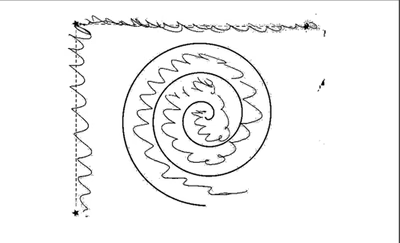
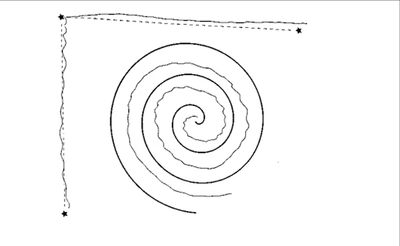
The same spiral, minutes apart
The Archimedes spiral is one of the three tasks scored blind in the study. These proof-of-concept tracings come from one person with moderate to severe Essential Tremor.
How the study was run
Nine adults with Essential Tremor did three tasks (drinking from a cup, finger to nose, and drawing an Archimedes spiral) under three conditions, in random order:
No device.
A weighted placebo device of identical appearance, with no active mechanism.
The Steadi-3 Blinding Recordings were masked, then scored blind by a neurologist on a modified Fahn-Tolosa-Marín scale. The scorer did not know which condition they were watching.
Funding
The study was designed, run and funded by Steadiwear Inc. (internal report, February 2025, available on request). Read the results with that in mind.2
Without the device
With the Steadi-3
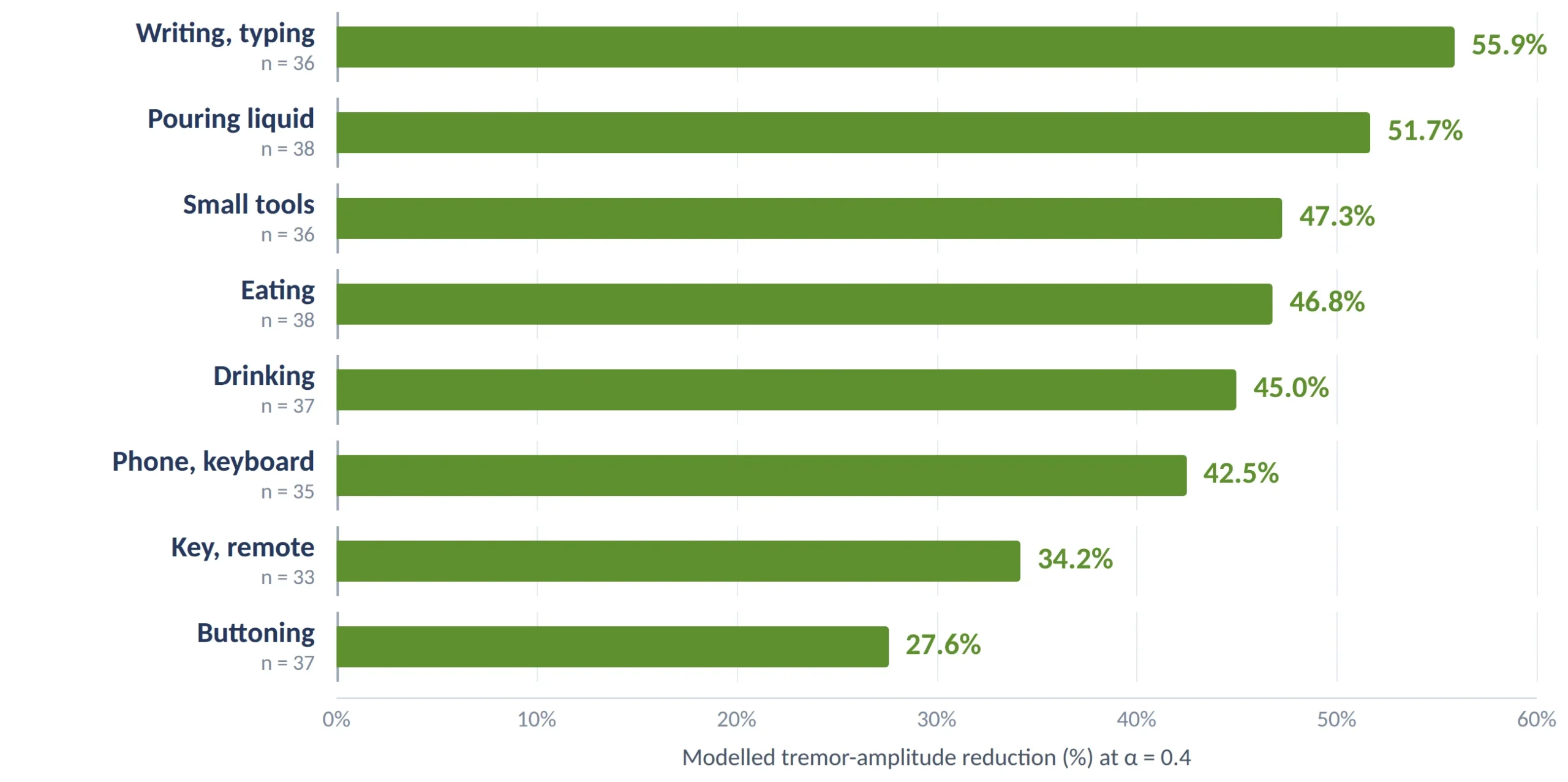
Post-market survey, 62 users
What users report in daily life
Users rated how hard eight everyday tasks were before and while using the device. Whole-hand tasks responded most: writing, pouring, eating and drinking. Fine finger tasks like buttoning responded least.3 These are estimates converted from self-reported difficulty, not measured tremor, and the survey has no comparison group. In a survey of users, people who chose to keep the device reported an estimated average tremor reduction of 44%. People who returned it reported almost no change.3
1. Steadiwear Inc. Steadi-3 Validation Study. Data on file. Improvement defined as a lower neurologist-rated modified FTM score in at least one of three tasks. 2. Relative reduction in mean score versus no intervention, calculated from reported means.
Bench Testing
On an instrumented six-degree-of-freedom test rig (November 2025), the Steadi-3 Plus reduced transmitted movement by 52% or more across the tremor range, and by 2 to 3 times more than the same weight added passively. Frequency analysis confirmed it adds no new vibration frequencies.4 A test rig is not a hand, so these figures show how the mechanism works, not how much a person’s tremor will drop.
Independent study of the earlier Steadi-1
Independent investigators with no financial tie to Steadiwear tested the earlier Steadi-1 in 20 adults with Essential Tremor, against a weight-matched 550 g sham glove. Measured acceleration was lower with the device than with the sham in three of four tasks, and significantly lower on spiral drawing. The results were presented at the 2026 International Congress of Parkinson’s Disease and Movement Disorders; the full paper is pending.5
Safety
No adverse events were reported in the one-week follow-up.1 The device is validated for up to 16 hours of continuous daily wear.10 It has no battery, electronics or skin stimulation. It contains permanent magnets and carries labelling for magnetic fields and MRI, so people with an implanted medical device should talk to their healthcare provider first.10
Limitations of this evidence
No randomised controlled trial yet. The controlled studies are small crossover evaluations (9 and 20 people).2,5
No head-to-head comparison with any other tremor device.
The evidence is mostly in Essential Tremor. Parkinson’s Disease is represented by 5 survey respondents and no controlled data.3
Three of the four datasets were designed, run or funded by Steadiwear.1
The survey is self-reported and unblinded, and its amplitude figures are estimates.3
About 2 in 10 participants did not improve compared with no device, and 3 in 10 compared with the placebo.2
Durability beyond one year of wear is not yet characterised.1,10
Evidence in progress
A real-world outcomes manuscript is under revision at Tremor and Other Hyperkinetic Movements.3
The full paper from the independent Steadi-1 study is pending.5
A multi-hospital clinical study is under way in Turkey, covering Essential Tremor and Parkinson’s Disease.1
A three-year post-market durability survey is planned.1
Sources
Steadiwear Inc. Clinical Evidence Summary, STDW-CES-001 Rev 01, 13 October 2026.
Steadiwear Inc. Blinded placebo-controlled performance evaluation of the Steadi-3. Internal report, February 2025. Available on request.
Steadiwear Inc. Post-market activity-difficulty survey, N = 62. Manuscript under revision, Tremor and Other Hyperkinetic Movements.
Steadiwear Inc. Six-degree-of-freedom bench validation report, November 2025. Available on request.
Shi RB, Rizek P. Clinical and kinematic evaluation of a tremor-damping glove in essential tremor. Mov Disord. 2026;41(suppl 1).
Fahn S, Tolosa E, Marín C. Clinical Rating Scale for Tremor. In: Jankovic J, Tolosa E, eds. Parkinson’s Disease and Movement Disorders. 1988:225–234.
Lora-Millán JS, Hidalgo AF, Rocon E. A Review on Wearable Technologies for Tremor Suppression. Frontiers in Neurology. 2021.
Mo J, Priefer R. Shaking Up Essential Tremor: Peripheral Devices and Mechanical Strategies to Reduce Tremor. Tremor and Other Hyperkinetic Movements. 2024.
Therapeutic Goods Administration. Australian Register of Therapeutic Goods, ARTG entry 531390 (Steadi-3 Plus).
Steadiwear Inc. Clinical evidence. steadiwear.com/pages/clinical-evidence (accessed 4 November 2026).
Pahwa R, Dhall R, Ostrem J, et al. An Acute Randomized Controlled Trial of Noninvasive Peripheral Nerve Stimulation in Essential Tremor. Neuromodulation. 2019;22(5).